Distribution and fate of microplastics from the Chesapeake Bay to the Mid-Atlantic Bight: A Lagrangian particle tracking approach
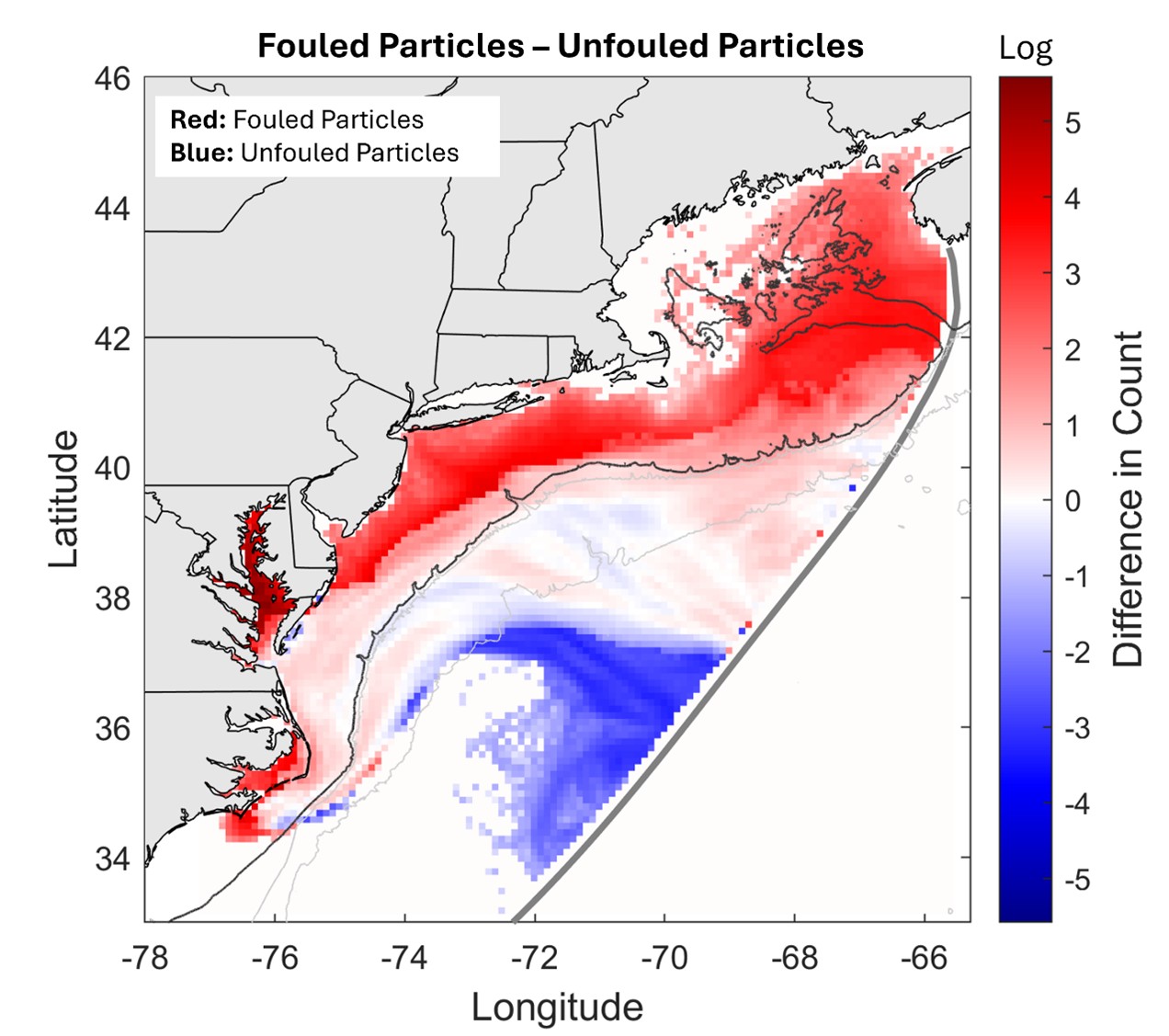
Abstract: Estuaries play a critical role in mediating the flux of land-derived microplastics to the ocean, where they pose a threat to marine ecosystems. This study investigates the fate of microplastic particles exported from the Chesapeake Bay (CB) to the Mid-Atlantic Bight (MAB), using an offline Lagrangian particle-tracking approach coupled with a 3D hydrodynamic model (SCHISM). Particles were released hourly from 17 locations at the mouth of Chesapeake Bay, totaling 148,920 particles over one year. Ten sensitivity experiments were conducted, exploring how polymer type (polyethylene, polypropylene), particle size (0.001 mm, 5 mm), and biofouling influenced their distribution patterns. All scenarios showed high frequency of particles reaching Virginia and North Carolina bays. Unfouled buoyant microplastics were mainly transported southward along the Virginia and North Carolina shelves, with limited northward movement restricted to the outer shelf and offshore. When biofouling was included, particle distribution broadened and extended northward to the Gulf of Maine. As biofouled microplastics sank, interactions with cross-shelf circulation enhanced transport into inner-shelf and estuarine regions in the MAB. While polymer type had negligible effects on transport, particle size played a major role. Larger biofouled microplastics (5 mm) did not sink during the one-year simulation and followed distribution patterns similar to unfouled microplastics. Their residence time on the MAB shelf ranged between 17-19 days, whereas smaller biofouled microplastics (0.001 mm) had residence time nearly twice as long, between 31-34 days. These results underscore the importance of incorporating biofouling into predictive transport models to better assess microplastic fate in coastal systems.

Manuel Colombo
Assistant Professor of Marine Science
Biogeochemistry Across Boundaries // VIMS and W&M